Thursday, July 14, 2011

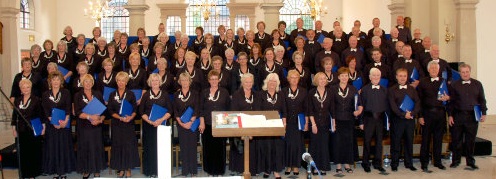
HOWARD WALLACE CHORALE


MUSIC FOR A SUMMER'S EVENING
Howard Wallace Chorale at the Bishops Hill Centre
09.07.11

Choral singing has been dragged back into the limelight, thanks to the likes of Gareth Malone and Last Choir Standing. No longer confined to the madrigal, the church or the valleys, the genre has embraced Broadway and the charts.
This is the populist path long followed with great success by the wonderful Howard Wallace Chorale. And last Saturday, under the imposing Bishop Hill roof, I finally heard what all the plaudits are about.
They began [and ended, in fact] with Bridge Over Troubled Water, sung from memory, and their Summer Evening music meandered through Elgar, Stanford, Copland at the classical end, and Harold Arlen, Swing Low and Unchained Melody from the Easy Listening shelf. Which also included a new arrangement of Wonderful World by the choir's founder, Howard Wallace, who has now passed the baton to their present charismatic conductor Tim Rhys-Morgan. The hard-working accompanist was Steven Miller.
Three choir members sang showpieces – Marion Davies the Novello favourite Waltz of my Heart, Angela Rose a beautifully phrased number from Showboat, and Angela Broad, in a fetching feather boa, that virtuosic party piece from Herbert's The Enchantress. Nostalgic Friday Night fare.
There were two generous medleys, too, from Lennon and McCartney and the Abba jukebox musical Mamma Mia.
A welcome change of pace and style from the generally relaxed tempi of this repertoire was Copland's Little Horses, sung with panache and precision by the ladies alone.

THE STONDON SINGERS - BYRD


THE STONDON SINGERS
Byrd Anniversary Concert at Stondon Massey
05.07.11

To Stondon Massey, for the annual concert commemorating the life and music of William Byrd. The Stondon Singers, under the exacting direction of Christopher Tinker, first gave us a suitably upbeat Sing Joyfully with a nice echo effect for “blow the trumpet”; Byrd’s contribution also included three Alleluias, and, from his secular pen, This Sweet and Merry Month, and a lively dance for Amaryllis which bounced beautifully along to follow the interval Pimms and pretzels.
There was Tallis, Sheppard and Stravinsky, and a second Sacrum Convivium from the modern British composer Gabriel Jackson – beautifully crafted in a sumptuous style with more than a hint of Whitacre and the French Romantics.
Tomas Luis de Victoria was featured too, in a performance of a mass from 1592 notable for the richly woven colours of the Kyrie. Victoria shares his 400th birthday this year with the King James Bible, and that work was celebrated with an impressive new piece from Michael Aves. “A Vision of the Word” was a challenge which the choir met with their customary diligence and enthusiasm; the harmonies of “Alpha and Omega” and the closing exhortation to “Write!” especially thrilling.
The concert ended with two helpings of Imogen Holst – The Twelve Kindly Months, and a dramatic arrangement of Gypsy Davy.

THE MIKADO


THE MIKADO
Shenfield Operatic Society at the Brentwood Theatre
06.07.11

Lots of débuts in this very enjoyable trip to Titipu, not least Rick McGeouch's as director. His Mikado was a pleasingly traditional take on G&S, with superb set design, striking oriental costumes and inventively used fans. The strangely configured stage was brilliantly used; the Act One finale was especially well choreographed [Annette Harris]. But he did allow himself a few modern modifications: I liked the King's Speech spoof; I was less sure about the trashing of Tit Willow.
He did have a fantastic cast to work with. Stuart Brown's comic Koko, his roots in the rag trade still showing, gave a performance to treasure in the Lytton part. His Little List, entirely updated, even-handedly included both Waitrose and The Only Way Is Essex.
Simon Cook's light tenor was well suited to Nanki-Poo, and he proved a fine actor, too. His Yum Yum was Louise Stuckey, in her first leading role for Shenfield – she has a lovely soprano, and was entirely convincing as a graduate of a ladies' seminary. Her two giggling companions were Hannah Matthews-Jones as a perky Peep-Bo and Lauren Ramshaw as Pitti-Sing, very effective in the ensembles.
Nina Jarram [a G&S virgin] made a wonderful Katisha – touching at times, but mostly a terrifying predator.
Neil Sturgess was a well-characterized Lord High Everything Else, and Boot Banes a revelation as the Emperor – an imposing figure with a memorably mirthless laugh. [I'd no idea his armoury included the Savoy Canon.]
Adrian Ure was the MD [his first time with Shenfield, too], heading up an unusual reduction for woodwind and piano.

Tuesday, July 12, 2011

MAIDEN LADIES


MAIDEN LADIES
Latchingdon Arts and Drama Society at the Tractor Shed
09.07.11


Paxton and Hoile were once names to conjure with in our villge halls and our weekly reps. My colleagues and mentors Peter Andrews and Gilbert Sutcliffe cut their critical teeth on the kind of pot-boilers that are now all but forgotten.
Maiden Ladies is a classic example, snatched from oblivion by the enterprising Peter Jones and his LADS.
We're straight back to the old am-dram days here, when cues were missed, corpsing was rife and the prompt worked harder than some of the cast.
This particular farcical comedy needed a deal of concentration at the start, when names are dropped and schemes are laid. All to do with what is coyly called a “romantic weekend” in a lovely cottage in deepest Surrey, threatened by the untimely arrival of the mother [Beth Greaves] together with the awful Eric [David Hudson]. Decency must be preserved, so the Maiden Ladies of the title must be impersonated, giving Reggie [a very enjoyable performance from talented farceur Daniel Turnbridge] a chance to slip into several sets of female attire, variously aided and thwarted by his valet Martingale [Arthur Barton], as they make a couple of Charley's Aunts of themselves.
Jamie-Leigh Royan's Calerie looked and sounded a woman of the period in her 30s slacks; Jemma Walshley's blonde Sylvia seemed closer to Essex than Surrey.
Robert Strange did his best with the rather thankless Heath, and I enjoyed Moir Gunfield's formidable vicar's wife.
Bill Wright was the city spiv sent to plunder The Cedars, but the plum cameo here was Robin Warnes' district dick, a prototype Truscott with a nice line in physical comedy and a disconcerting tic which made his name a strangulated “Crutch”.
I admired the impressively massive beam across this late Tudor cottage, and there were many nice moments of pure farce – the whisky bottle, the moving table, for instance. But elsewhere we were in Farndale country, with some prime examples of coarse acting, my favourite perhaps the unglazed door.
As John Folkard remarks in his excellent programme note, this kind of play is almost pre-history to today's young actors. All credit to Latchingdon for bringing it back in all its ghastly glory.

Saturday, July 09, 2011

THE TURN OF THE SCREW


THE TURN OF THE SCREW
at London’s Little Opera House at the King’s Head Theatre
07.07.11


Britten's claustrophobic treatment of Henry James would seem ideally suited to the tiny stage at Islington's King's Head.
Edward Dick's tightly focused production used a bare stage, two chairs and a gauze to conjure up the great house at Bly.
The projected images [Richard Bleasdale] added little to the atmosphere, but I liked the prologue, with David Menezes pacing around Katie Bird's damaged Governess with his case-notes in his hand, and at the last revealed as a psychiatrist, with the sinister Miss Jessel his nurse.

Modern dress is hard to square with the story – children are thankfully no longer entrusted to governesses – and this wicked world of mystery and imagination almost demands a period setting. I could put up with Quint's leather jacket, or Miles's trainers, but Mrs Grose [impressively sung by Laura Casey] I could not stomach as an overgrown teen from the Little Britain gallery of grotesques. Hair in bunches, Hug Me shirt, pigging sweets and swigging cola, she looked like the kind of babysitter you'd be wise to keep well away from your children. She was unnecessarily close to the new governess, too, I thought. And in general there was too much physical intimacy. The dark undercurrents, subtly suggested by Britten's score, are best kept under – we can surmise an unhealthy relationship between Quint and Jessel without seeing them enjoy a quickie on an uncomfortable wooden chair.

Musically there was much to admire, not least Musical Director David Eaton's heroic efforts at the piano, playing a fiendish reduction with sympathetic passion and superb technique. The children [Samuel Woof and Eleanor Burke on press night] were excellent at suggesting drowned innocence; Flora was beautifully sung, while Miles caught the subtle expression and meaningful glances that give his character its enigmatic allure. Menezes was a brooding, haunted Quint, using a broad dynamic range to develop an intense persona. Catrine Kirkman was a striking Jessel, dark, Gothic and a powerful presence. But the discovery of the evening was Katie Bird's Governess. Her fine acting drew us into her disturbing world, and her voice was outstanding, even in this strong young cast, rich and nuanced, with eloquent phrasing and excellent diction.
This was my first visit to what now bills itself as London's Little Opera House. The benches are not the most comfortable; the room quickly became stuffy. But to see opera this close, at this standard, is a rare treat – what an inspired idea, giving young singers a chance to shine, and audiences an operatic evening out at pocket-money prices.

this piece first appeared on The Public Reviews