Friday, March 18, 2011

PRIVATE LIVES
Oldham Coliseum Theatre and Harrogate Theatre, in association with Anvil Arts, at the Mercury Theatre, Colchester
for The Public Reviews

15.03.11
until March 19th
then at the Haymarket Basingstoke, March 22nd to 26th
This Northern Coward is not the Manchester in-the-round experiment, but a much more predictable staging which started life in the Coliseum Oldham, and arrived at the Mercury by way of Harrogate.
And hugely enjoyable it proved.
Beautiful period costumes, two lovely contrasting sets [Michael Holt] – the balconies of the Deauville hotel, light and Art Deco, with the kind of curtains that billow, and the plush fin-de-siècle flat in the rue Montaigne, with its grand piano, divans and cabinet phonograph. And performances that were just as stylish, directed with affection and a practised hand by Robin Herford.
Noel Coward wrote the play in less than a week, with himself in mind of course for the peach of a part that is Elyot Chase. James Simmons' Elyot had clearly been around a bit, with his co-respondent shoes, his lived-in face and his wry cynicism. He timed the bons mots to perfection, and, like his Amanda, had an elegance of gesture which suited the period. Jackie Morrison played Amanda with superb sophistication and endearing honesty – the kitten marked for tragedy. Her voice was absolutely right, and she sang the snatches of Coward wonderfully. These two actors played very well together - I loved the recognition scene, and the domestic intimacy of the pyjama-clad tête-à-tête in Act Two. Their enforced silences were very imaginatively handled, and the famous fight was painfully physical – fight director Renny Krupinski.
Their new spouses, younger, with much to learn about the ways of the world and the foibles of the idle rich, were Maeve Larkin as a pretty little Sybil, not lacking in spirit, and Christopher Naylor as a tweedy, Woosterish Victor. The exasperated domestique was nicely suggested by Tess Alshibaya.
Music is key to the piece – Coward wrote Someday I'll Find You specially for the first production – and both piano and gramophone were effectively used [MD Howard Gray]. Not so sure about the “cheap music” in Act One: it sounded more like Mantovani than the house band at the Hotel Royal. And the sound-scape had the disconcerting effect of placing the audience in the middle of the marina.
This is not exactly a ground-breaking production, but the cast are always convincing and spark off each other brilliantly, breathing new life into these familiar lines, never resorting to cliché or pastiche. The Master's brittle wit is well served in a constantly entertaining couple of hours.
this piece first appeared on The Public Reviews


Sunday, March 13, 2011

GOODNIGHT, MR TOM

Children's Touring Partnership at the Theatre Royal Norwich

10.03.09

Douglas Byng [“England's finest cabaret artiste”] came to entertain Norwich in 1941. Not of course the only Londoner uprooted to the Sticks in those unsettled, insecure times, as this marvellous adaptation [by David Wood] of Michele Magorian's novel reminds us.

William Beech is evacuated to rural Dorset, and finds himself billeted with grumpy, reclusive Tom Oakley. Each has demons to battle, and they both emerge stronger from the experience.
Oliver Ford Davies made a wonderful Mr Tom. Though maybe he softened too quickly, his simple kindness and the pain repressed deep inside were both economically suggested. And, the day I saw it, Oliver Tritton Wheeler was a perfect Will – slight, shy, nervous, his body language was always eloquent. A contrast of course with the other Londoner, Max Longmuir's extrovert Zach. Child of actor parents, he is at the centre of the amateur theatricals which, appropriately, loom large in Wood's version.
Michele Magorian started out as an actress, too, and the story was written between jobs, apparently.
I hope she appreciated the ingenious casting that gave Aoife McMahon both the awful mother and the angelic primary school teacher – the key women in Will's young life. Another nice double from Anne Kavanagh as kindly shopkeeper and chain-smoking, mannish doctor – a very recognisable period character this.
Like the novel, the play pulls no punches on the grim realities of war, which even idyllic Weirwold cannot escape. Robert Innes Hopkins' scene design uses two GWR-style posters for London and Dorset, and in an impressive revelation for a touring set, raises its platform to make the Beeches' dingy London basement flat. The costumes were very authentic looking, too. I liked the way Will's green pullover was taken from him as he left the country to be with his sick mother. And Sammy, Will's faithful four-legged friend, who, Lassie-like, leads the rescuers to the grim flat, was brought to vibrant, panting life by Laura Cubitt.

As so often, the language received less care. “There you go ...” and “hopefully” were little heard in the Forties.
And the matinée audience – seniors of Oakley's age [who remembered Virol] and schoolchildren of William's – was not the easiest. Nonetheless, a superb production, directed by Angus Jackson, of an important story.

UP OUT O' THE SEA
Eastern Angles at the Town Hall, Maldon
10.03.11
touring until June 4th
for The Public Reviews

Off the lonely Suffolk coast, eroded by the relentless waves, a wreck has lain for thirty years. Now it is to be brought to the surface, just as a prickly journalist from London turns up in the the tight-knit local community, with her laptop and her searching questions.

That's the starting point for Andrew Holland's Up Out o' the Sea, an atmospheric piece dealing with those Eastern Angles stock-in-trade themes of origins, ghosts and time-slips.

A simple, weathered set sits across the Town Hall in Maldon, replicating the John Mills Theatre back in Ipswich. “Fresh Fish For Sale – Special Offer Herring £1.50 lb” at one end, with a suggestion of the mooring and the remote Point. At the other, the village library.

The company of five bring some pretty complex characters to life, as their stories unfold and intertwine. Rough-edged chancer Tweedie, looking for love and a way out of the dead-end, was played by Francis Woolf, who caught precisely the mixture of bravado and vulnerability. His colleague, Dolphie, the only survivor of the volunteer crew that attempted the rescue on that fatal night, was Mike Aherne, who managed to make the grumpy old fishermen both believable and sympathetic.

Lisa-Marie Hoctor played two linked characters, both immature, both young mothers; sometimes hard to grasp all her words in this less than ideal acoustic, but I loved her Emily, the mysterious girl with a touch of the devil, who dreams of passing through into glory …
Laura Harding was brilliantly convincing as the writer with secrets of her own – the picnic at the Point was movingly done, as was the “information versus emotion” dialogue with Lisa-Marie's modern Milly.
And Lisa Tramontin played the Librarian, by no means a stock character, despite her stereotype hair and cardigan. Though not all of the dialogue she was given rang true, she did provide some of the most touching moments in a play of many layers and textures. Including the key revelation, a real goosebumps realisation.

Music was powerfully used – a Bach Passion mainly – and simple but effective lighting suggested the sunshine and the showers, the night and the storm. The setting was practical and versatile - I admired the imagination that turned a door with oilskins hanging from hooks into a stretcher for the victims of the storm.

In the end, after a rescue which echoes the earlier disaster, they decide to leave the wreck where it lies – a memorial draws a line under a past event whose details are gradually revealed in this intriguing piece, directed, with his usual sure touch for the intangible, by Eastern Angles' Artistic Director Ivan Cutting.

production photograph: Mike Kwasniak
this piece first appeared on The Public Reviews


RADIANCE
Music of Light – The Writtle Singers at All Saints' Church
12.03.11


This satisfyingly ambitious programme was one of the Singers' best.
It began with plainsong – a form older than the building in which we were listening – with the choir processing to the four corners of the nave. Here they gave an impressive performance, from memory, of the challenging twenty-first century motet O lux beata Trinitas, a setting of words by St Ambrose.
James McMillan's Missa Brevis was the central work. Again, beautifully delivered, especially in the closing Agnus Dei, with its finely grained Miserere and its movingly humble Dona Nobis Pacem.
There was Bach, too, Brewer and Bairstow, whose I Sat Down Under His Shadow had a lovely diminuendo at the end.
Simon Harvey was at the organ – as soloist he gave Fireworks by Handel, and joined the Singers' inspirational director at the piano for a light-hearted duet from Fauré's Dolly Suite.
Secular music to finish, though in the lovely Saint-Saens Calme des Nuits it was really only the words that were secular. Not so in the delicious luminescent lollipops - On the Sunny Side of the Street and I'm Beginning to See the Light - sung with the same passion, the same precision, as the Holst, the Wood or the Rutter.

Saturday, March 12, 2011

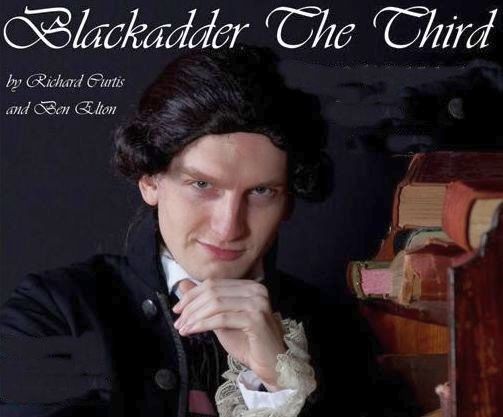
BLACKADDER THE THIRD
Chelmsford Theatre Workshop at the Old Court
11.03.09

A week to go till Red Nose Day itself, but the Old Court is packed with fans and friends for three episodes from the penultimate series.
Director Dean Hempstead had chosen Ink and Incapability – the one about Dr Johnson's dictionary – Nob and Nobility – the one about the Scarlet Pimple – and Sense and Senility – the one with the actors and the anarchist. Had they been writing last week, Messrs Curtis and Elton might well have titled it The Prince Regent's Speech.
For we're in the Regency – the palace interior done up to match the new décor in the auditorium. Vivaldi joining Howard Goodall on the soundtrack, three marvellous Romantic poets, and best of all, the Prince George himself, a man “with all the wit and sophistication of a donkey”, obsessed with trousers, given a wonderful characterization by Kevin Stemp. I couldn't help being reminded of another idle scrounger scion of the royal line, the one who allegedly tells his 'Blackadder' to F*** Off every morning as he draws the royal curtains.
At the heart of the play, the relationship between Edmund and his sidekick, roles played again this time out by David Chilvers – not so “rubberfaced” as the original, but suaver and timing his laughs with consummate skill, and the comic genius Mark Preston.
A couple of guest appearances added to the gaiety of nations – Mike Nower as the Drury Lane thesp Keanrick, and Hempstead himself as the luddite Anarchist.
this production runs from March 15th to the 19th at The Old Court - ring 01245 606505 to check availability ...

Jim Hutchon saw the show for the Chelmsford Weekly News:
There is a feeling among the audience at the start that we have been catapulted into the strange world of television. The characters are familiar and straight from the TV series, and the actors, especially David Chilvers as Blackadder and Mark Preston as Baldrick, stay superbly in character from the opening scenes.

That said, it quickly becomes apparent that a live stage play can take liberties that a TV series can’t, and the extra dimension adds enormously to the sheer fun and enjoyment of Dean Hempstead’s masterly production.
Kevin Stemp as the peanut-brained Prince George harrumphed his deluded way through the action, and his trousers really stopped the show. Another show stopper was Tony Ellis in an evocation of the effects of poison that was pure slapstick.
It says much for CTW’s depth of talent that even minor roles played by the group’s heavyweights are given added impetus. Actors such as Steve Parr as a marvellously convincing Dr. Johnson, Mike Nower acting as an effete Restoration actor and Robin Winder as a greasy Frenchie make this a genuinely enjoyable evening.
This is CTW’s contribution to Comic Relief, where the aim is to beat their previous Blackadder’s contribution of £2,000.