Thursday, June 02, 2011

SHE LOVES  ME
The Minerva, Chichester Festival Theatre
01.06.11

“It's a far cry from 'Allo Allo' ...”

Overheard just before the overture of She Loves Me, in the cosy Minerva at Chichester. How true. The jewel-case set, designed by Anthony Ward, has the Parfumerie window on a revolve, with a fin-de-siecle street scene on a cloth behind, a classy tiled floor and the band raised up on either side.

Joe Masteroff's book imagines an epistolatory love affair – it would later inspire You've Got Mail – between two people who just happen to be employed in the same Budapest store. And it's by no means brainless – Mann and Stendhal are both referenced.

In Stephen Mear's enormously enjoyable revival, the frankly so-so musical numbers are treated as if they were Loewe, Cole or Coward, by a cast of superb singer/dancer/actors who really know how musical comedy should be done.

The romantic leads were Dianne Pilkington's Amalia, and Joe McFadden's Georg, but the true delights of this production were the supporting players – twinkly, rotund Jack Chissick as Mr Maraczek, Gavin McCluskey as the delivery boy, Lee Ormsby as the Maitre D of the louche, decadent night club [inexplicably the only character with a British accent] and especially Annette McLaughlin as Ilona, the long-suffering second string who finally finds her optometrist Mr Right in the library.

The stand-out number was the Christmas Shopping sequence, ever more manic as the calendar counted down. I also liked Maraczek's wistful Days Gone By, and the recurring Call Again Madam jingle as the shoppers leave the store.

It's hard to imagine this slight but charming show being better served. Will it transfer to the West End, like last year's chamber musical Love Story ?
ASSUMPTION
Mercury Theatre Colchester
31.05.10

Simon Turley's moving piece was written for an all-female company touring rural Cornwall in the 90s. It was directed then by Dee Evans. Now the Mercury's Artistic Director, she has returned to the play to direct this revised revival.

It is a marvel that such a perceptive, heartfelt drama could be penned by a playwright who is neither Irish nor a woman. And that he manages to combine deeply textured allegory and myth with such a light touch.

The text often strays from the naturalistic – revelation, Holy Mother of God, the music of the spheres. There is pure poetry – a shiver “stutters up the spine” - and biblical language. There are images and symbols galore: the names, the looking glass most tellingly. And there are moments of sheer joyful invention: the breath of the angel captured in a blue balloon [its sisters floated down on us as we stood up to leave], the randy shopkeeper's new dentures.

The story follows the fate of a fallen woman in rural Ireland. Her mother is in despair; her priest packs her off to the Sisters of Mercy for “repairs, not repose”. But the child in her womb is not the result of sin – not Sean, but an apparition, is the father. Though a higher purpose is never even hinted at here. Unlike Our Lady, though, Gabriella has no Joseph to rely on, and refuses the honour; it is her friend Anna [Nadia Morgan] who bears a child.

Emily Woodward was brilliantly believable as Gabriella, proud, scared, innocent, defiant, – her scenes with her mother [another fine, moving performance from Christine Absalom, with every detail wonderfully expressive] were very strong, especially the harsh ending to Act One, and the sequence where Absalom remembers calming her child's night terrors - “swaying and hoping”. The down-to-earth angel, appearing in several disguises, was played by Amanda Haberland, who made her a very approachable being, even in the Annunciation. Her moment of glory – on clouds descending – was neatly punctured by her “I hoped you'd be impressed!”. The nuns were represented by the naïve Assumpta [Morgan again] who plans a grotto and a shrine for the sainted Gabriella, and a cruelly rigid Reverend Mother – Gillian Cally, who also had a nice character role as Shamie, the disreputable relative who might have taken Gabriella to wife.

Dee Evans' direction did much to underscore the message and the magic of the piece. The opening sequence, with the child and the lament, which both appear again at the end, the confession with its weighty crucifix, the laundry where you could almost smell the washing, and the shrinking wall of light at the back, ingeniously suggesting the door and the distance. Adam McCread's soundtrack, too, though never intrusive, made a huge contribution to the show.

An impressive ensemble piece, beautifully staged, deeply affecting without being preachy or sentimental, leaving us to reflect on the role of religion, the family and our own angelic encounters.


this piece first appeared on The Public Reviews


CHELMSFORD SINFONIETTA FESTIVAL
at Chelmsford Cathedral
27.05.11


Poulenc's eventful Organ Concerto, given a masterly performance by Andrew Millington, felt like the climax to this year's impressive Festival; the strings of the County Town's own professional orchestra [leader Suzanne Loze] were bright and alert, with eloquent lower voices, in the ominous Molto Agitato, for example.
But there was still Elgar and Tchaikowsky – a scintillating Serenade for Strings - to look forward to after the convivial interval, both played with affection and expression, and a deeply lustrous string tone, by the Chelmsford Sinfonietta under Richard Studt. Saturday's concert got under way with Grieg's much-loved Holberg Suite, with its solemn Sarabande and exuberant Rigaudon.
In the opening event, more Poulenc, his Sextet, in which Tim Carey's piano was joined by five excellent wind players. Mischievous, lyrical and acerbic by turns, it provided a refreshing contrast to the Mozart Quintet [a relaxed, conversational start to the evening] and the richly Romantic Thuille Sextet, scampering gaily to its conclusion, with just a moment's pause for rapt reflection.
Another discovery this year, was the Serbian accordion duo whose repertoire ranged from Vivaldi through Mendelssohn to Piazzolla, with some traditional and contemporary works thrown in for good measure.
This is the fourth such festival, organized and inspired by Festival Director Tim Carey. It makes for welcome red letter days in our cultural calendar, and we hope that a way can be found to ensure its survival next year and beyond.

MUCH ADO ABOUT NOTHING

MUCH ADO ABOUT NOTHING
Theatre at Baddow
27.05.11


It's the season of Much Ado – two major productions either side of the Thames, an open air national tour, and Theatre at Baddow choosing this witty comedy as their first ever crack at the Bard.
Jo Windley-Poole's lively production romped through Shakespeare's “merry war”, relishing the “clash of wits” between the worldly-wise Beatrice [Claire Lloyd, in an assured reading] and Benedick, an agreeably cynical Roger Saddington. Sometimes the words could have been given a little more breathing space, and often the transitions between scenes could have been tighter.
Scarcely a weak link in a large company - I was particularly impressed with Ellie March's young Hero, touching in the wedding scene with Jim Crozier's thoughtful Leonato. Tony Ellis mastered the space and gave resonance to the text as John the Bastard, making a believable brother for Nick Milenkovic's Don Pedro. Vicky Wright was a pert and largely unrepentant Margaret, with Beth Crozier making the most of Ursula, Hero's other gentlewoman. John Kensett looked every inch the “learned constable”, and was suitably smug – his Watchmen, though, were reduced to an old man and a couple of lads, all three played by women …
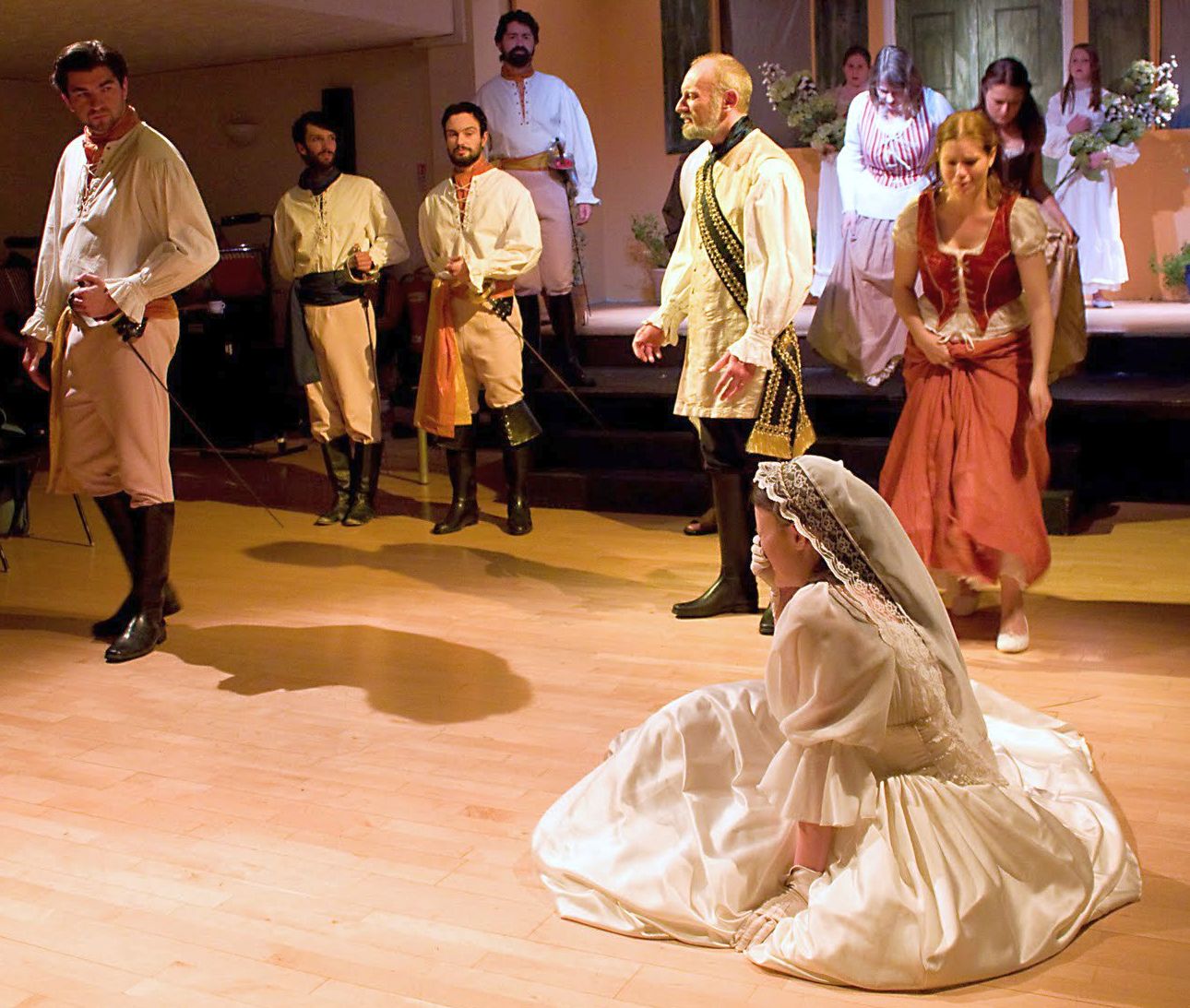
Production values were high – warm lighting, terracotta colours for the set, neat beards for the gentlemen, stylish costumes by Jane Hunt, with gorgeous masks for the ball, and wonderfully appropriate music for recorders and keyboard, played live, and specially composed for this production by Owain Jones.

Wednesday, June 01, 2011


COWARDY CUSTARD
at the Civic Theatre
25.05.11

This glorious pot-pourri of words and music by Sir Noel Coward was first staged while The Master was still with us. Together with its many imitators, it's remained popular ever since.
The present touring version, with just five talented and industrious performers, retains much of the charm and the humour of the original, while adding some effective touches of its own.
One such was the emotive inclusion of the London Bombings, alongside the Blitz, in the London Pride sequence. Sir Noel would have approved the patriotic, propagandist sentiments. And also the restoration of one of his personal favourites, Matelot.
The great strength of this revival was the use of cabaret stars at the top of their game – Dillie Keane, who was priceless in a bilingual Marvellous Party and I Wonder What Happened To Him, and the inimitable Kit and the Widow – Mrs Worthington and Twentieth Century Blues.
The two fresher faces were equally impressive – Stuart Neal dancing in Red Peppers and Room With A View, and Savannah Stevenson superb in the exhausting Coconut Girl audition sequence.
The very simple staging, with its phonograph and its grand piano, was effectively used; the sound reinforcement I found intrusively bright at times, but not enough to detract from a wonderfully potent reminder of this unique “talent to amuse”.